
Brachycephalic Obstructive Airway Syndrome
Brachycephalic Obstructive Airway Syndrome (BAOS / BOAS)
A combination of anatomical abnormalities of the upper respiratory tract typical of brachycephalic breeds. In the French Bulldog it is one of the most common and impactful health conditions affecting quality of life.
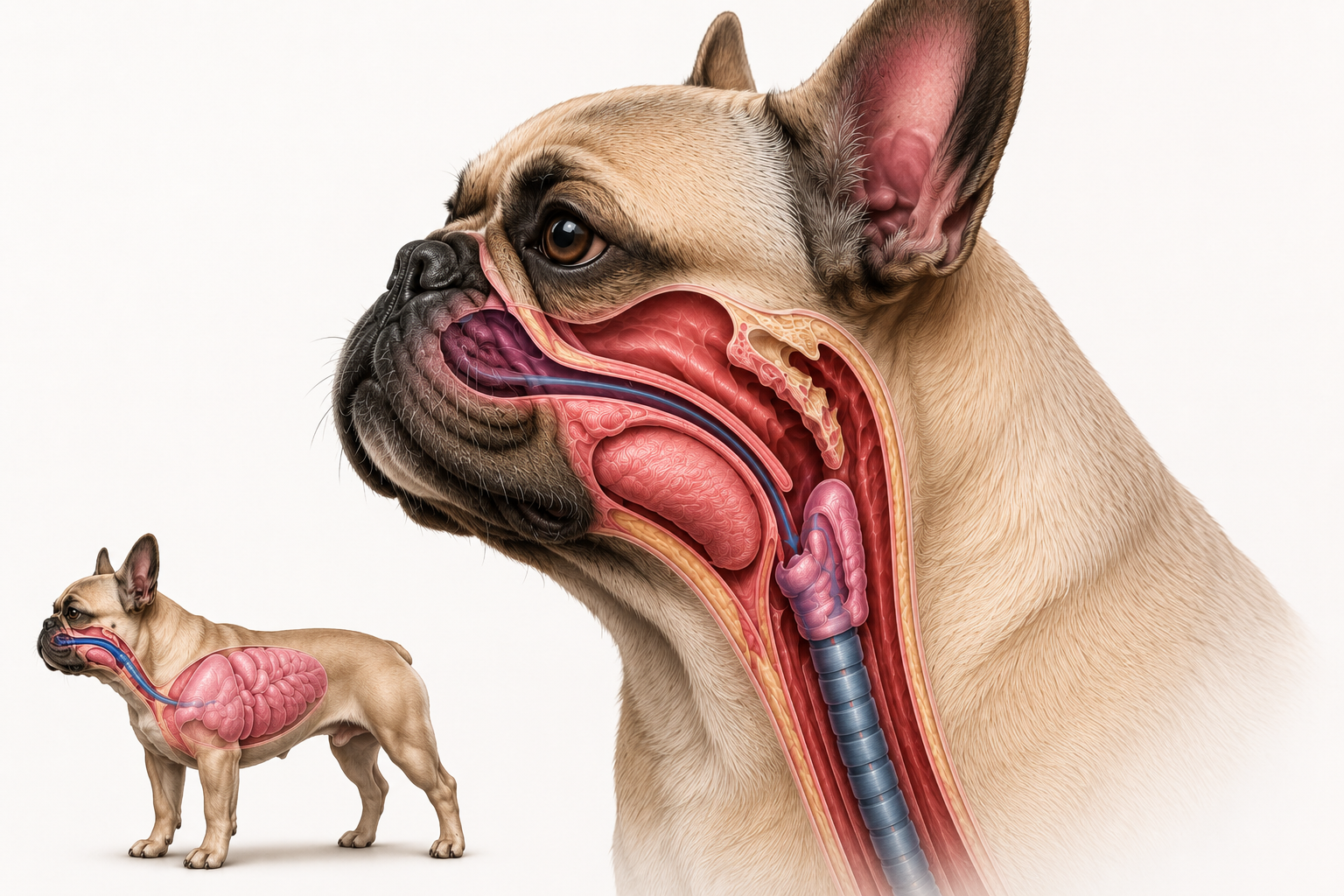
Hover over or tap a hotspot to highlight the anatomical structure.
📋 At a glance
System affected
Respiratory system
Upper airways: nostrils, soft palate, larynx, trachea.
Most affected breeds
French Bulldog
Also English Bulldog, Pug, Shih Tzu and other brachycephalic breeds.
Age of onset
From a young age
Can be present from birth, though symptoms often become more apparent as the dog grows.
Progression
Chronic
Can worsen progressively without proper management.
Main symptoms
Noisy breathing
Snoring, heat intolerance, fatigue after physical exertion.
When to see a vet
Constantly noisy breathing
Or if the dog shows recurring fatigue even at rest.
When it's an emergency
Severe breathing difficulty
Blue lips or tongue (cyanosis), collapse, loss of consciousness.
🫁 Airway anatomy
Hover over or tap a hotspot to highlight the anatomical structure.
What is BOAS?
Brachycephalic Obstructive Airway Syndrome (BOAS) is a combination of anatomical abnormalities of the upper respiratory tract typical of brachycephalic breeds, including the French Bulldog.
Unlike a single disease, BOAS is a syndrome — a cluster of abnormalities that can occur simultaneously and obstruct the normal flow of air.
In the French Bulldog the short muzzle, selectively bred over the years for aesthetic reasons, reduces the space available within the airways. Although the skull bones are shorter than in other breeds, many soft tissues (such as the soft palate and other throat structures) remain similar in size to those of long-nosed dogs. This causes a narrowing of airflow and makes breathing more laboured.
The severity of BOAS varies considerably from dog to dog. Some French Bulldogs show only mild snoring, while others can develop severe respiratory insufficiency requiring surgery.
Did you know?
Many French Bulldogs breathe noisily from puppyhood, but this does not mean it is normal. Persistent snoring is often one of the first signs of BOAS and deserves a veterinary evaluation.
Why is BOAS so common in the French Bulldog?
The French Bulldog is one of the breeds most predisposed to BOAS.
The main abnormalities that can contribute to the syndrome include:
- stenotic nares (very narrow nostrils);
- elongated and thickened soft palate;
- laryngeal collapse in advanced cases;
- everted laryngeal saccules;
- hypoplastic trachea (in some dogs);
- increased respiratory effort which, over time, can worsen existing abnormalities.
These conditions can occur simultaneously or in different combinations, which is why each dog requires an individual veterinary assessment.
How does it affect the dog's life?
A French Bulldog with BOAS may struggle to perform activities that are normal for other dogs.
Situations that often worsen symptoms include:
- intense physical exercise;
- high temperatures;
- high humidity;
- stress or excitement;
- overweight or obesity.
In severe cases the dog may struggle to maintain adequate oxygenation, increasing the risk of heat stroke and other respiratory complications.
What happens in the airways?
During inhalation the dog must create negative pressure to draw air into the lungs.
When the airways are narrowed:
- the effort required to breathe increases;
- soft tissues are sucked inward;
- the passage of air narrows further;
- breathing becomes increasingly noisy and laboured.
This mechanism can worsen progressively over time if not managed properly.
Typical progression of BOAS
Puppy
Snoring
Panting during play
Worsening with heat
Veterinary assessment
Better quality of life with proper management
Puppy
Snoring
Panting during play
Worsening with heat
Veterinary assessment
Better quality of life with proper management
Symptoms of BOAS
Symptoms of Brachycephalic Obstructive Airway Syndrome (BOAS) can range from mild to very severe. Some French Bulldogs show only slight snoring, while others may develop marked breathing difficulty that limits normal daily activities.
Symptom severity depends not only on the anatomical abnormalities present, but also on factors such as ambient temperature, humidity, level of physical activity, body weight and general health status.
Noisy breathing
This is one of the most characteristic signs of BOAS.
The dog may make sounds during inhalation or exhalation even when relaxed. These sounds result from air passing through narrowed airways.
Snoring
Many owners consider snoring "normal" in French Bulldogs.
In reality, frequent or particularly loud snoring can be one of the first signs of clinically significant brachycephalic syndrome.
Exercise intolerance
During walks or play the dog may:
- stop frequently;
- breathe with heavy panting;
- refuse to continue;
- recover very slowly after exertion.
In severe cases even moderate activity can cause significant breathing difficulty.
Excessive panting
After minimal exertion or on hot days the French Bulldog may pant more than normal.
Persistent panting is a sign that the dog is increasing its breathing effort to compensate for airway obstruction.
Sleep disturbances
Some dogs with BOAS:
- snore intensely;
- change position frequently during rest;
- wake up frequently;
- sleep with the neck highly extended to ease the passage of air.
Regurgitation and gastrointestinal problems
Many dogs with BOAS also show digestive disorders, including:
- regurgitation;
- gastroesophageal reflux;
- retching;
- occasional vomiting.
Cyanosis
In severe cases the gums or tongue may turn a bluish colour (cyanosis), indicating reduced blood oxygenation.
This requires immediate veterinary attention.
Fainting or collapse
When oxygenation becomes insufficient, especially during intense physical exercise or in high temperatures, the dog may temporarily lose consciousness.
This is a veterinary emergency.
Causes of BOAS
BOAS is caused by a combination of anatomical abnormalities typical of brachycephalic breeds.
These changes are not acquired during the dog's lifetime but arise primarily from the genetically selected conformation of the breed.
Stenotic nares
The nasal openings are narrower than normal, restricting the entry of air from the very first section of the airways.
Elongated soft palate
The soft palate is longer and thicker than the available space in the throat.
During inhalation it may vibrate or partially obstruct the passage of air.
Everted laryngeal saccules
Chronic respiratory effort can cause small saccules in the larynx to protrude, further increasing obstruction.
Laryngeal collapse
In advanced cases the structures of the larynx can progressively weaken until they partially collapse.
This represents one of the most serious complications of BOAS.
Hypoplastic trachea
Some French Bulldogs have a trachea with a smaller-than-normal diameter.
This further limits the flow of air to the lungs.
Risk factors
Although BOAS is a congenital condition, several factors can worsen its symptoms.
Obesity
Excess weight increases the breathing workload and is one of the main aggravating factors.
Maintaining a healthy body weight is essential to reduce the load on the airways.
High temperatures
The French Bulldog dissipates heat mainly through breathing.
When the airways are narrow, this function becomes less efficient, increasing the risk of overheating and heat stroke.
High humidity
Humid air makes heat dissipation less effective and can worsen breathing difficulty.
Intense physical activity
Exercise increases the demand for oxygen.
With BOAS the dog may be unable to meet this demand, quickly showing panting and fatigue.
Stress and excitement
Anxiety, agitation or strong excitement increase the breathing rate and can temporarily worsen symptoms.
Disease progression
Chronic respiratory effort can lead to progressive worsening of anatomical abnormalities.
This is why early diagnosis and proper management can improve the dog's quality of life and reduce the risk of complications.
Diagnosis of BOAS
Diagnosis of Brachycephalic Obstructive Airway Syndrome is not based solely on whether the dog snores or has a short muzzle. The vet must assess how much the airway abnormalities actually interfere with breathing, physical activity, sleep, thermoregulation and quality of life.
It is important not to automatically consider persistent respiratory sounds, panting after mild exertion or difficulty tolerating heat as "normal for the breed". Even a French Bulldog apparently used to these symptoms may have a clinically significant obstruction.
History
The appointment typically begins with questions to the owner. The vet may ask:
- whether the dog breathes noisily even at rest;
- how far it can walk or play before stopping;
- whether symptoms worsen with heat, humidity, stress or excitement;
- whether it snores loudly or wakes during sleep;
- whether it sleeps with an extended neck or in unusual positions;
- whether there have been episodes of cyanosis, fainting or collapse;
- whether it shows regurgitation, retching, reflux or vomiting;
- how long it takes to recover after exercise.
Physical examination
During the visit the vet observes the dog at rest and evaluates:
- shape and opening of the nostrils;
- type and intensity of respiratory sounds;
- breathing rate and effort;
- colour of the mucous membranes;
- weight and body condition;
- tolerance to handling and stress;
- any associated gastrointestinal signs.
Post-exercise assessment
Some centres use a standardised exercise test. The dog is observed before and after brief controlled activity, to assess the appearance or worsening of:
- respiratory sounds;
- panting;
- difficulty recovering;
- exercise intolerance;
- changes in mucous membrane colour.
Airway examination
To directly examine the soft palate, larynx, laryngeal saccules and other deep structures, it may be necessary to examine the dog under sedation or general anaesthesia.
- excessively long or thick soft palate;
- everted laryngeal saccules;
- tonsillar changes;
- laryngeal collapse;
- other causes of obstruction.
Additional tests
Depending on symptoms and severity, the vet may recommend:
- chest and neck X-rays;
- blood tests;
- cardiac evaluation;
- endoscopy of the airways;
- advanced imaging such as CT scan;
- investigations for regurgitation, reflux or other gastrointestinal conditions.
Management summary by severity
General framework — always to be assessed with the vet
| Severity | Management |
|---|---|
| Mild | Monitoring and weight control |
| Moderate | Veterinary management and possible surgery |
| Severe | Specialist evaluation and surgery when indicated |
Treatment of BOAS
Treatment depends on the severity of symptoms, the anatomical structures involved, the dog's age and the presence of any complications.
BOAS is linked to the dog's anatomical conformation: daily management can reduce aggravating factors, but cannot widen stenotic nares, shorten an overly long soft palate or correct laryngeal collapse. In dogs with clinically significant obstruction surgical correction may therefore be indicated.
Conservative management
In mild cases or while awaiting further evaluation, the vet may recommend measures to reduce respiratory effort.
Weight control
Keeping the dog at an appropriate body condition is essential. Excess weight increases breathing effort and can worsen exercise and heat intolerance.
Physical activity management
Exercise should not be eliminated, but adapted to the dog's abilities. It is preferable to:
- choose short regular walks;
- avoid intense running;
- take frequent breaks;
- stop activity at the first signs of difficulty;
- avoid exercise during hot hours;
- not push the dog beyond its limits.
Heat and humidity protection
During summer it is important to avoid:
- walks during the hottest hours;
- parked cars;
- intense physical activity;
- prolonged sun exposure;
- closed, poorly ventilated spaces.
Stress reduction
Agitation and excitement increase the breathing rate. In a dog with narrow airways this can quickly worsen symptoms. It is useful to limit situations that cause intense agitation and let the dog recover in a quiet, cool environment.
Harness instead of collar
A well-fitted harness avoids direct pressure on the neck and trachea. It does not cure BOAS, but can make walks more comfortable and reduce stress on the airways.
Medical therapy
No medication can permanently correct the anatomical abnormalities underlying BOAS. However, the vet may use drugs to manage specific situations, such as:
- inflammation and oedema of the airways;
- associated gastrointestinal disorders;
- nausea, reflux or regurgitation;
- respiratory complications;
- acute episodes.
Surgical treatment
Surgery aims to reduce obstruction and facilitate the passage of air. The most common procedures include:
- correction of stenotic nares;
- shortening and reshaping of the soft palate;
- removal of everted laryngeal saccules;
- treatment of enlarged tonsils or other anomalous structures.
When is surgery considered?
Surgery may be considered when the dog has:
- persistent noisy breathing;
- significant exercise intolerance;
- difficulty sleeping;
- frequent panting episodes;
- worsening with heat or stress;
- respiratory crises;
- cyanosis or collapse;
- clinically relevant anatomical abnormalities.
Prognosis
Prognosis depends mainly on:
- initial severity of BOAS;
- number of structures involved;
- age of the dog;
- presence of laryngeal collapse;
- general health;
- obesity;
- associated gastrointestinal disorders;
- response to treatment;
- onset of complications.
Mild cases
Dogs with mild abnormalities, adequate weight and good exercise tolerance can maintain a satisfactory quality of life with careful management and regular veterinary check-ups.
After surgery
Many dogs show improved breathing, activity tolerance and quality of life after appropriate surgical correction. However, surgery does not make the dog anatomically equivalent to a long-nosed breed. BOAS is considered a chronic condition and may require subsequent follow-up.
Importance of early intervention
In general, outcomes tend to be better when the condition is identified and treated before chronic respiratory effort causes advanced secondary changes.
Advanced laryngeal collapse
The presence of laryngeal collapse reduces the chances of an optimal outcome. In advanced stages prognosis may be guarded or unfavourable, even after treatment.
Prevention
BOAS is mainly linked to the dog's anatomical conformation and cannot be completely prevented. However, careful management can help reduce the risk of symptom progression and improve the quality of life of the French Bulldog.
Maintain ideal weight
Excess weight increases breathing effort and is one of the main aggravating factors of BOAS. A balanced diet, combined with physical activity appropriate to the dog's ability, helps maintain a good body condition.
Avoid overheating
French Bulldogs have a reduced ability to dissipate heat through breathing. It is therefore advisable to:
- avoid walks during the hottest hours;
- always provide fresh water;
- prefer shaded areas;
- use well-ventilated or air-conditioned spaces during warmer periods;
- stop activity immediately if the dog shows signs of excessive panting.
Appropriate exercise
Exercise is important, but must be adapted to the dog's condition. Regular, moderate walks are preferable to very intense or prolonged activity.
Use a harness
A well-fitted harness reduces pressure on the neck and airways compared to a traditional collar.
Regular veterinary check-ups
Brachycephalic dogs should undergo regular check-ups, especially if they have marked snoring, noisy breathing, frequent panting or reduced exercise tolerance.
When is it an emergency?
Contact a vet immediately if your French Bulldog shows:
- severe breathing difficulty;
- very rapid or extremely laboured breathing;
- blue gums or tongue (cyanosis);
- collapse or loss of consciousness;
- inability to cool down after exertion;
- suspected heat stroke;
- breathing with mouth fully open accompanied by obvious distress;
- sudden worsening of usual symptoms.
Do not wait for the situation to improve on its own.
Frequently asked questions
Related articles
🫁 Associated anatomical abnormalities
Related symptoms
Related Emergency Guides
Sources
This page was prepared with reference to authoritative veterinary sources and scientific literature.
Ultimo aggiornamento: Luglio 2026
Main references
- 1.Merck Veterinary Manual – Brachycephalic Airway Syndrome
- 2.American College of Veterinary Surgeons (ACVS) – Brachycephalic Syndrome
- 3.Cornell University College of Veterinary Medicine – BOAS
- 4.British Small Animal Veterinary Association (BSAVA)
- 5.World Small Animal Veterinary Association (WSAVA)
- 6.PubMed – Brachycephalic Obstructive Airway Syndrome
Disclaimer
The information on this page is intended solely for informational and educational purposes.
It does not in any way replace a veterinary examination, diagnosis or treatment prescribed by a veterinarian.
If your French Bulldog shows breathing difficulties or other symptoms described on this page, contact your vet promptly.
The information in the Diseases Center is for informational purposes only and does not replace a veterinary visit, diagnosis or treatment.